Why Old Roofing Felt Fails in High-Water Areas
This article is adapted from Mikel Wallesen's video above.
Read the video transcript
When we tear off an old tile roof here in Arizona, the first thing I look at is the underlayment. On most older homes that means 30 lb felt. And almost every time, the same story shows up in the same spots: the valleys, the eaves, anywhere water concentrates and runs hard. That is where the felt gives out first, and that is where leaks start.
This post walks through why that happens, what we do differently when we reroof, and what homeowners should actually be paying attention to before the next monsoon.
What 30 lb Felt Actually Is
30 lb felt is an asphalt saturated paper. When it goes down new, it is flexible, dark, and has enough asphalt in it to shed water and seal around fasteners. It was the standard underlayment under tile roofs in the valley for decades, and on a low slope shaded roof in a mild climate it can last a long time.
Arizona is not that climate. Our roofs see brutal UV through small gaps and vents, deck temperatures well over 160 degrees in summer, and almost no humidity for most of the year. Felt is organic. It needs some of its oils to stay pliable. Bake it long enough and those oils cook out.
Why Valleys and High-Flow Areas Fail First
Felt does not fail evenly. It fails where it works the hardest.
Valleys collect water from two roof planes and funnel it down a single channel. Every storm, every irrigation overspray, every dew morning, that water is sitting on or running across the same strip of underlayment. Eaves are similar. Water sheets off the field of the roof and accumulates at the bottom edge before it spills into the gutter or off the drip edge.
When felt dries out, it gets brittle. Brittle felt in a wet channel does not bend with the deck, it cracks. Once it cracks, water gets under it, runs along the deck, and finds the nearest nail hole or seam. By the time a homeowner sees a stain on the ceiling, that valley has probably been leaking quietly for a year or two.
The field of the roof, where water only passes through, usually still looks okay when we tear it off. The valleys look chewed up.
What We Use Instead
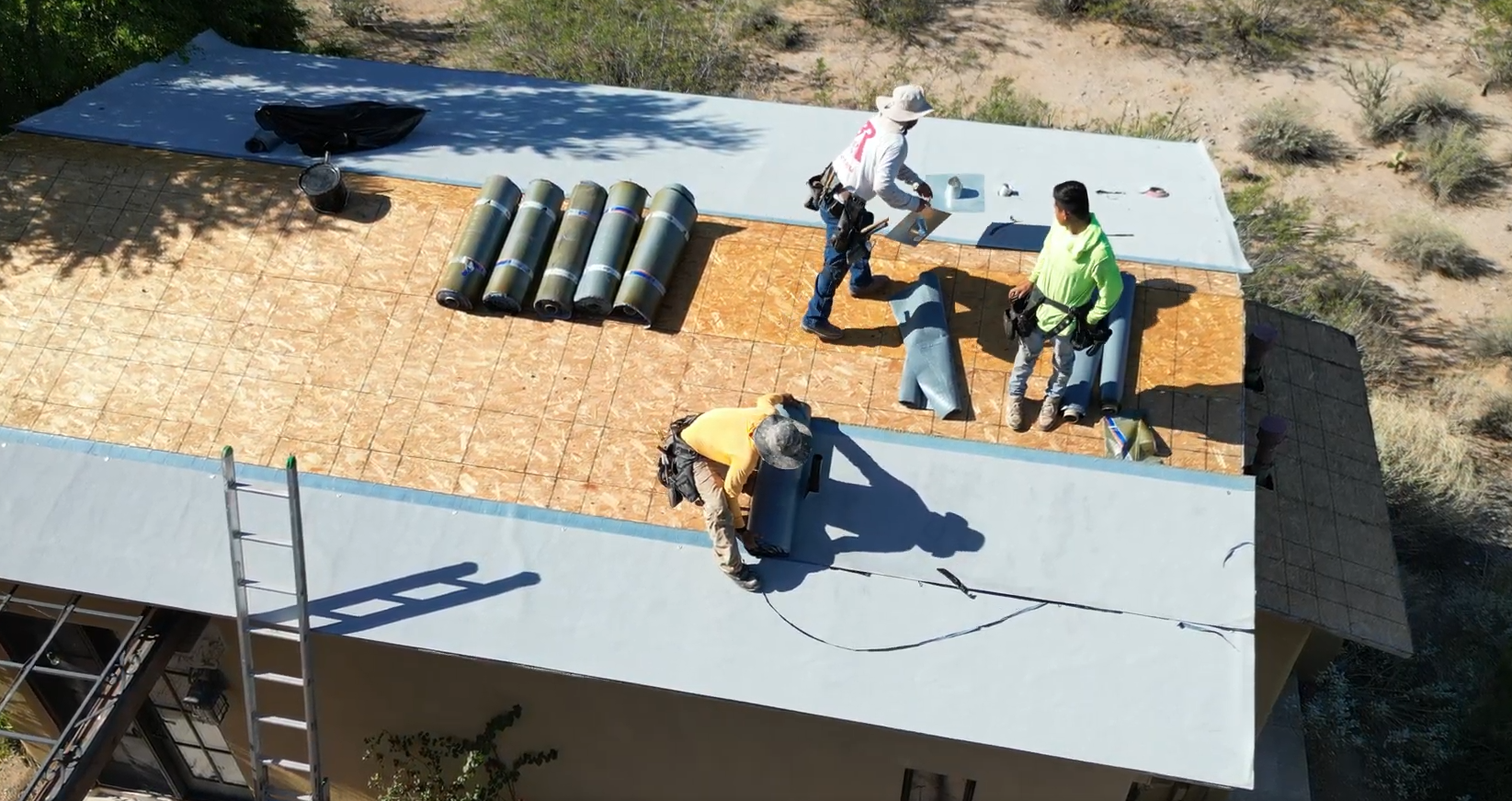
On every reroof we do, the critical areas get a granular peel and stick underlayment, not felt. Peel and stick is a self adhering membrane with a rubberized asphalt back and a granular surface on top. It bonds directly to the deck. There is no nail hole at the bottom of a valley with peel and stick, because the membrane is the seal.
We run it up every valley, across every eave, around every penetration, and anywhere a wall meets the roof. In high-water zones it is doing the actual waterproofing. The field underlayment is there to back it up.
The difference shows up after about ten years. A felt valley at ten years is already getting fragile. A peel and stick valley at ten years still looks like the day it went down, because the granular top protects the asphalt from UV and the membrane stays bonded to the wood.
Why This Matters for Tile Roofs Especially
Most people think the tile is the waterproofing on a tile roof. It is not. Tile is the wear layer. It takes the sun, the hail, the foot traffic. The underlayment is what actually keeps water out of the house.
That means when the underlayment in the valleys fails, the roof is failing, even if every tile on top looks perfect. We see this all the time. A homeowner gets a leak, climbs up, sees clean unbroken tile, and assumes the roof is fine. Then we pull a few tiles in the valley and the felt underneath is cracked, curled, and pulling away from the deck.
If your tile roof is fifteen or twenty years old and the underlayment has never been touched, the valleys are the first place to check.
What Homeowners Can Watch For
You do not need to climb on the roof to spot trouble. A few things to keep an eye on:
Stains on the ceiling near interior walls that line up with a valley above. Water tracks along framing, so the stain is rarely directly under the leak.
Loose or slipped tiles in or near a valley. When the underlayment shrinks and pulls, it can lift the lower courses of tile out of position.
Granules in the gutters or at the downspout. If you had peel and stick installed and you start seeing a lot of granular shed, that is worth a call.
Any visible black underlayment in a valley when you look up from the ground. If you can see felt poking out past the tile, sun is hitting it and accelerating the breakdown.
What a Reroof Should Include
If you are getting bids on a tile underlayment replacement, ask each contractor exactly what they are putting in the valleys and at the eaves. A bid that uses 30 lb felt across the entire roof is the cheapest option and the shortest lived. A bid that uses peel and stick in the valleys, eaves, and around penetrations and a quality synthetic or double layer felt in the field is what will actually buy you another 25 plus years.
Cheaper bids tend to leave the high-water areas exposed to the same failure mode that brought the old roof down. That is not a deal, that is the same problem on a new clock.
If you are not sure what is up there or you have a leak you cannot trace, we will come out, pull a few tiles, and show you what your underlayment actually looks like. No pressure, no upsell. Just an honest look so you can decide what to do next.
Call us anytime for a free inspection.