The Hidden Product That Helps Keep Tile Roofs Dry
This article is adapted from Mikel Wallesen's video above.
Read the video transcript
Most of what keeps a tile roof dry is stuff you never see once the job is done. Weather blocker is one of those things. It is a small product, it does not cost much, and plenty of roofs in the valley get built without it. We put it on every hip and ridge we install.
Here is what it does and why we bother.
What Weather Blocker Actually Is
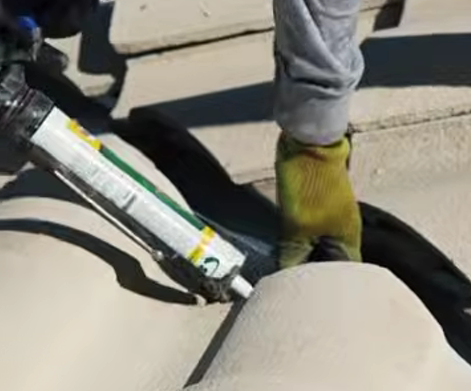
It is a flexible closure strip that sits under the hip and ridge tile, running along the line where two roof planes meet. Think of it as a gasket between the field tile and the cap tile sitting on top of it.
Tile roofs are not watertight by design. The tile is a shedding surface. Water runs down the top of the tile and off the roof, and the underlayment below is the real waterproofing layer. That system works fine when water goes where gravity tells it to go.
The problem is wind.
Why Hips And Ridges Are The Weak Spot
When a storm rolls in and the wind is blowing sideways, water does not just run downhill anymore. It gets pushed. It gets driven up under the edges of the tile and into the gaps at the hips and ridges, which are the highest and most exposed lines on the roof.
Without a closure there, you have an open channel right at the peak. Wind pushes water in, and now it is sitting on your underlayment instead of running off the top of the tile where it belongs.
Weather blocker fills that gap. It closes the void between the cap tile and the field tile so the wind has nothing to push water through. The water stays on top of the tile and runs off the roof the way it is supposed to.
What This Means Over The Life Of Your Roof
Underlayment is what stands between water and your plywood. Every gallon that gets under the tile is a gallon your underlayment has to deal with, and underlayment has a service life. The more water it handles, the harder it works, and the sooner it starts to break down at the nail penetrations and the laps.
Cutting down the amount of water that gets under the tile is one of the cheapest ways to extend the life of the whole system. You are not adding a fancy product. You are just closing a hole that should not be open.
In Arizona this matters more than people expect. We do not get constant rain, we get monsoon storms with hard wind and heavy water in short bursts. That is exactly the condition where wind driven water gets behind tile. A roof can go months bone dry and then take a beating in one afternoon.
How To Tell If Your Roof Has It
You usually cannot see it from the ground. If you are having work done or you are getting an inspection, ask directly whether the hips and ridges have a weather blocker or closure installed under the cap tile. On a mud set roof the mortar does some of this job, but on a foam set or mechanically fastened ridge, the closure is doing the work.
If your roof was built without it and the tile is otherwise in good shape, it is not an emergency. It is something to address the next time the ridge gets reset or the underlayment gets replaced.
Why We Do It Every Time
It is a small line item. It takes extra time on every hip and every ridge. It does not show up in photos and no homeowner ever compliments us on it.
We do it because the parts of a roof that fail early are almost always the details, not the material. Getting the details right is the whole job.
If you want someone to actually look at how your tile roof was put together, give us a call and we will come out and take a look at no charge.