How Long Does a Spray Foam Roof Take in Scottsdale?
This article is adapted from Mikel Wallesen's video above.
Read the video transcript
"So the timeline of a spray foam roof," I say in the video, "it could take 3 to 5 days or it can take all the way up to a couple months."
That's a wide range, and people are usually surprised by it. They expect a roof to be a roof: book it, show up, finish it. Spray foam doesn't work like that. It's a product that reacts to heat, and in Arizona the weather has as much say in the schedule as the size of the building does.
I'm Mikel Wallesen, owner of Big Red Roofing. I took this business over from my father, and we've been Scottsdale roofers since 1987. In two short videos I explained what drives a spray foam timeline and why wind is one of the things we watch closest. Here's the longer version, plus what you should ask any foam contractor before they set a start date.
How long does a spray foam roof take to install in Scottsdale?
A spray foam roof can take a few days or as long as a couple of months. The size of the roof sets the starting point, and the weather and time of year decide the rest.
A small flat section on a house can be prepped, foamed and coated in a matter of days. A large commercial building is a different job. There's more surface to clean, more foam to put down, more coats to build and more chances for the weather to push us off the roof. That's how the same type of roof can take three days on one job and a couple of months on another.
Where people get frustrated is when a contractor promises a fixed finish date on a big foam job without talking about weather. That date is a guess. If a contractor tells you exactly when a large foam roof will be done before the first day, ask them what they do when the wind picks up or the temperature drops. A straight answer about delays is worth more than a confident date.
Why does the weather matter so much for spray foam?
Because spray foam is a heat-driven product. As I say in the video, "Because spray foam is a heat-driven product, that's a big driving component also is the weather and the climate and what we're dealing with."
Spray foam is mixed at the gun from two parts that react and expand on the roof. That reaction depends on temperature, both the air and the surface we're spraying. Get the conditions right and the foam rises and sets the way it should. Get them wrong and it can set poorly, which shows up later as a roof that doesn't perform the way it's supposed to.
So the weather isn't just about comfort for the crew. It's part of the chemistry. That's why we'd rather wait for the right conditions than force a schedule. Pushing foam onto a roof in bad conditions to hit a date is one of the worst shortcuts in this trade, because you won't see the problem on day one. You'll see it months later, after the crew is long gone.
Does the time of year change how long the job takes?
Yes. The season changes how many good working hours we get each day, and that changes the total timeline. In the video I point to "the time of year that we perform this work" as a big factor.
Arizona has its own rhythm. In the hottest part of summer, a roof surface can get too hot to work well in the middle of the day, so crews often start early and stop when the heat peaks. Monsoon season brings sudden wind and storms that can shut a day down without much warning. Cooler months can be easier on the crew but can bring mornings that are too cold for the foam until the sun warms things up.
None of that is a reason to avoid foam. It's a reason to plan around the calendar. If you have a commercial building and some flexibility, talk with your roofer about timing. Starting in a stretch of steady, workable weather can shorten the job a lot compared to starting at the edge of monsoon season.
How does wind affect spray foam and roof coatings?
Wind is one of the biggest factors we watch. As I explain in the second video, "We try to stay under 10 mph on the wind because anything over that, you're really getting a lot of overspray and you're wasting a lot of product."
When foam or coating leaves the gun, it's a fine spray. A light breeze is manageable. Past that, the wind starts carrying the material off the roof. That's overspray, and it causes two problems. Product that blows away isn't on your roof, so the layer can end up thinner than it should be. And it has to land somewhere: cars, windows, AC units and the neighbor's property.
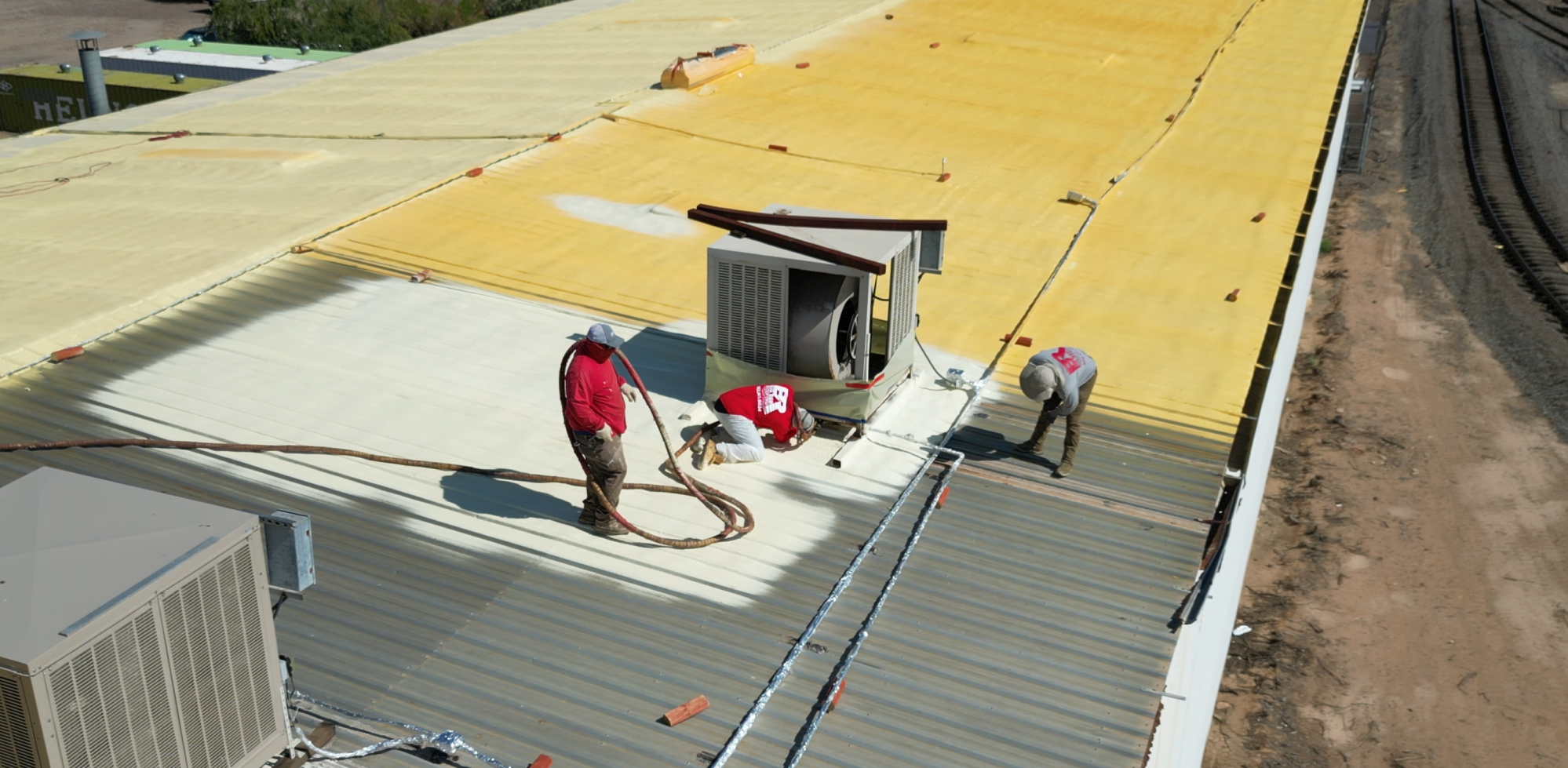
That's why some days we're on the roof and some days we're not, even when the sky is clear. Calling off a windy day can look like a delay, but it protects the roof and everything around it. We also protect what's near the work before we spray. You can see how a foam job runs start to finish in what happens when you spray foam a metal roof, and the coating side in how the final coat should go on.
What happens between the foam and the final coat?
After the foam goes down, it gets coated, because spray foam on its own isn't built to sit in the sun. The coats are part of the timeline, and each one needs the right conditions too.
Foam is the insulation and the waterproof body of the roof. The coating on top protects that foam from UV and gives the roof its finished surface. On many jobs that means a base coat and then a top coat. On metal buildings, we often use a tan base coat first so the crew can see where the white top coat is going. I cover why in how we protect metal spray foam roofs with base coats.
Every one of those coats depends on the same things as the foam: temperature, wind and a clean surface. That's why the timeline isn't just "spray day." It's prep, foam, and coats, each on a day when the weather cooperates. A contractor who rushes the coats to finish early is cutting into the part of the roof that protects everything else.
What should you ask a contractor about a spray foam schedule?
Ask what conditions they need to spray, what they do when those conditions aren't there, and how they'll keep you posted. Their answer tells you whether they'll protect the roof or protect the schedule.
A good foam contractor will tell you their wind and temperature limits without hesitating. They'll explain how prep, foam and coats fit together on your roof and roughly how many working days each one takes. They'll also be honest that weather can stretch it. If someone promises they'll finish on a set date no matter what, they're either very lucky or they're going to spray in conditions they shouldn't.
Ask about the people around the work, too. On a business, that means tenants, parked cars and rooftop equipment. On a home, it's the cars in the driveway, the windows and the yard. You want to hear how they'll cover and tape things off before the first pass, not after something gets hit.
What happens when you call Big Red Roofing about a spray foam roof in Scottsdale?
We look at the roof, explain what the job involves from prep to the last coat, and give you an honest range for how long it will take, including how weather could stretch it.
On a foam job we're checking the existing roof surface, what it will take to clean and prep it, the drainage, and everything on the roof we'll need to protect or work around. We've sprayed foam across the Valley on homes, new construction and big metal buildings like this Phoenix commercial metal roof and this new construction spray foam roof. Big Red Roofing is licensed under AZ ROC #276008 and holds an A+ rating with the BBB. You can read about the company or about me.
To get started, use our contact page. For a ballpark first, try the estimator, and see our pricing page for how foam is priced. We handle spray foam roofing and commercial roofing in Scottsdale, Phoenix, Tempe, Mesa, Chandler and Glendale.
Frequently Asked Questions About Spray Foam Roofs in Scottsdale
How much does a spray foam roof cost in Scottsdale?
It depends on the size of the roof, the prep it needs and how many coats go on top. We don't quote numbers without seeing it, but our pricing page explains how foam is priced and the estimator gives a ballpark.
Can you spray foam in the summer heat?
Yes, but the hottest hours can be too much for the roof surface, so crews often work early in the day. Heat is part of how foam reacts, so we watch it closely.
Why did my foam contractor stop work on a sunny day?
Usually wind. Past a light breeze, overspray blows product off the roof and onto cars, windows and neighbors, and the layer on your roof ends up thinner.
Does spray foam need a coating?
Yes. Spray foam isn't UV resistant on its own, so it gets coated to protect it from the sun and give the roof its finished surface.
Is spray foam a good choice for a commercial building?
It's one of the best options for big flat and metal roofs here, because it insulates and waterproofs in one continuous layer. See our commercial roofing page for more.
Can spray foam go on a house?
Yes. We foam flat sections on homes and new builds, and we also handle tile roofing and shingle roofing for the rest of the house.
How do I schedule a spray foam estimate?
Reach out through our contact page and we'll come look at the roof. We'll walk you through the steps and the timeline before you commit to anything.